Translated from Ludwig Distel's German.
Settling in Villingen
At the beginning of the 19th century far-reaching political changes took place in
Villingen. For Villingen, a town of some 3,300 inhabitants at the time, centuries
of Austrian rule ended in 1802. After years of back-and-forth as a consequence of
Napoleon's redrawing of the map of Europe, Villingen found its new political home
in 1806 in the Grand Duchy of Baden. Much of the self-assurance that had grown up
with the town's old rights of self-government had to be given up in favour of a
tight, uniform Baden administration. Conversely, though, the new state offered
better prospects of advancement to people who had had fewer chances under the
closed hierarchy of the old order.
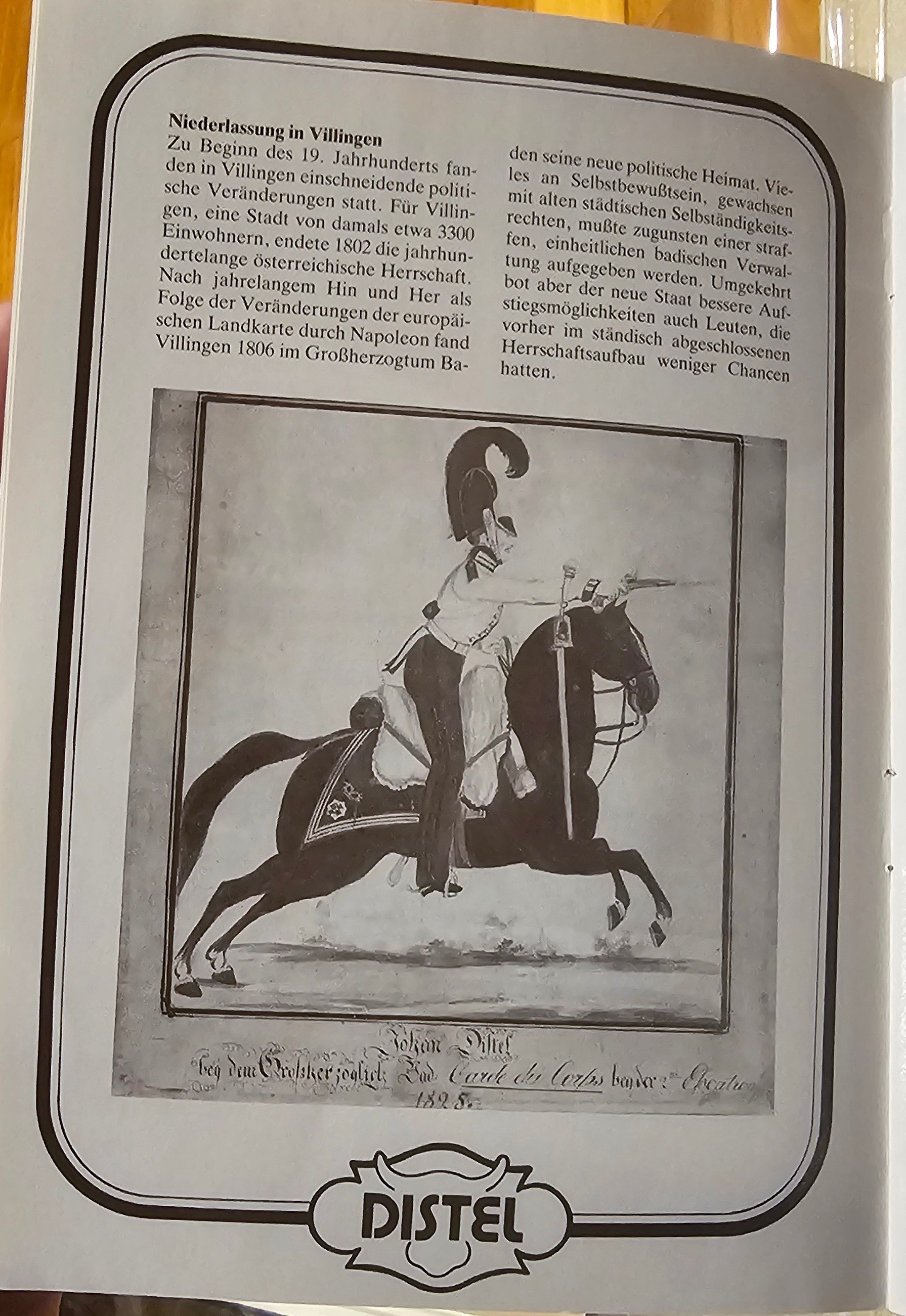
[a painting of a cavalryman on a rearing horse, inscribed below in a
contemporary hand:]
Johan Distel
with the Grand Ducal Baden Garde du Corps, 2nd squadron
1825
[shop sign:] DISTEL
The German as printed in 1986, as transcribed.
Niederlassung in Villingen
Zu Beginn des 19. Jahrhunderts fanden in Villingen einschneidende politische
Veraenderungen statt. Fuer Villingen, eine Stadt von damals etwa 3300
Einwohnern, endete 1802 die jahrhundertelange oesterreichische Herrschaft. Nach
jahrelangem Hin und Her als Folge der Veraenderungen der europaeischen Landkarte
durch Napoleon fand Villingen 1806 im Grossherzogtum Baden seine neue politische
Heimat. Vieles an Selbstbewusstsein, gewachsen mit alten staedtischen
Selbstaendigkeitsrechten, musste zugunsten einer straffen, einheitlichen
badischen Verwaltung aufgegeben werden. Umgekehrt bot aber der neue Staat
bessere Aufstiegsmoeglichkeiten auch Leuten, die vorher im staendisch
abgeschlossenen Herrschaftsaufbau weniger Chancen hatten.
[Gemalte Darstellung eines Kavalleristen auf sich aufbaeumendem Pferd,
darunter in zeitgenoessischer Handschrift:]
Johan Distel
bey dem Grossherzoglich Bad. Garde du Corps bey der 2ten Escadron
1825
[Schild:] DISTEL