Family Archive
The Distel Family
Letters, diaries and photographs, gathered and shared, one person at a time.
Family Archive
Letters, diaries and photographs, gathered and shared, one person at a time.
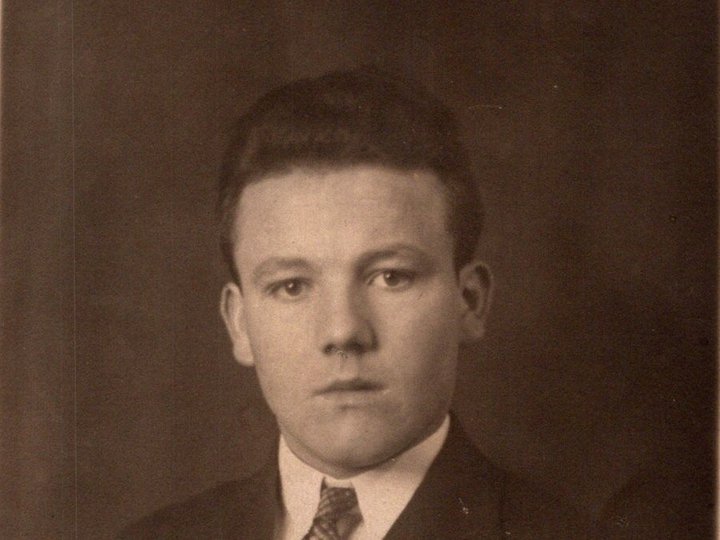
1906 - 1972
A hairdresser from Villingen in the Black Forest, who left home at seventeen and worked his way across Germany, Sweden and Switzerland before sailing for Australia in 1928. He kept a diary for ten years of it.
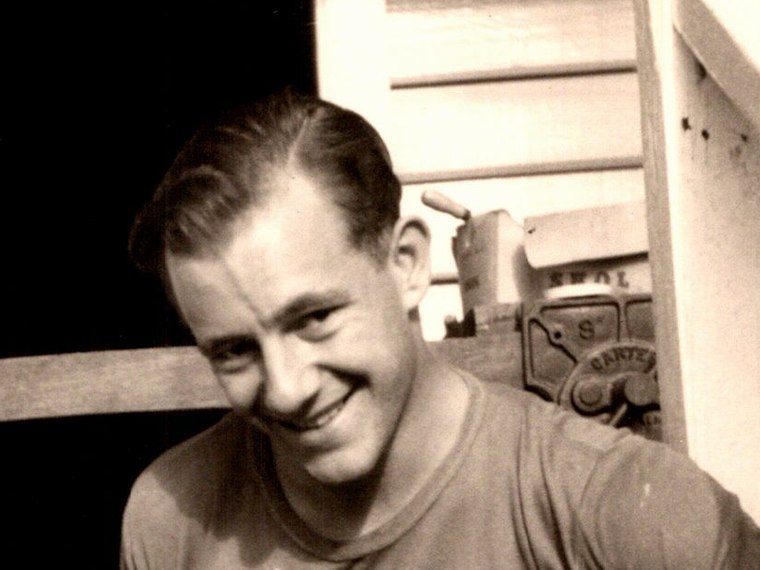
1939 - 2008
Willi’s eldest son. Twenty-two years in the Royal Australian Air Force, then a country grocer at Beaufort, and the family’s own genealogist, whose research this archive is built on.
Further generations will be added here as their papers and photographs are gathered up.
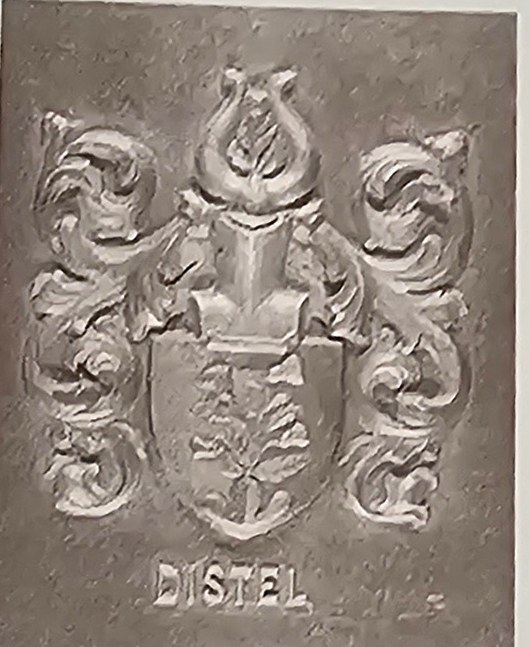
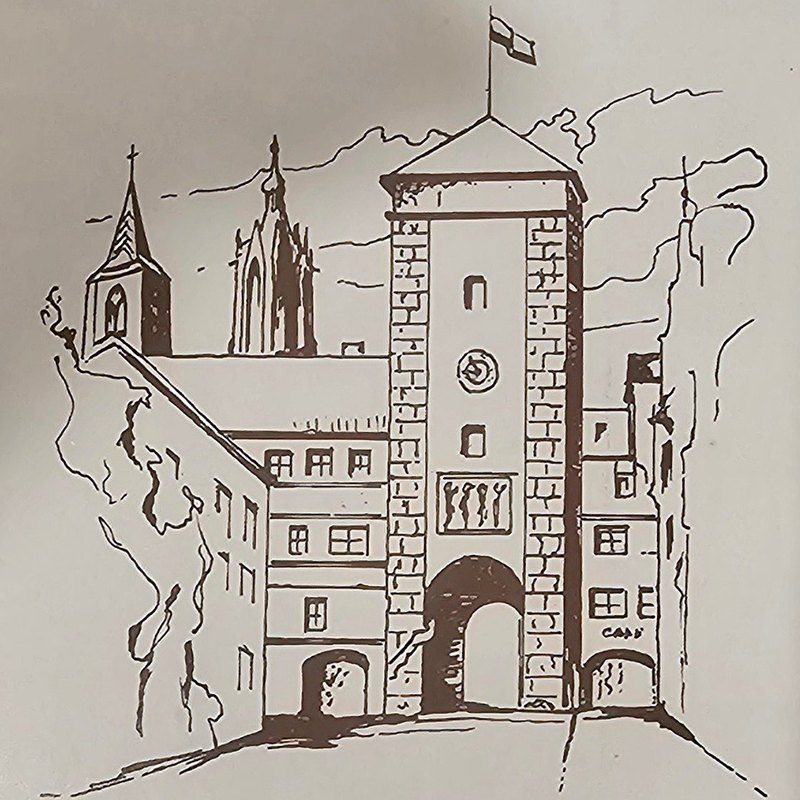
Familienwappen. The drawing at the top of this page was made from this photograph in 2026. No blazon of the arms has been found, and nothing is recorded about who carved the plaque, or when.
Distel is the German word for a thistle, and the arms carry one: a thistle in flower on the shield, and a second as the crest above the helm. It is the kind of arms a family gives itself out of its own name.
The oldest exact record of the family is 390 years old and comes from the
parish archive at Seitingen. On 1 July 1636, in the middle of the Thirty
Years War, the saddler Christian Distel of Seitingen married Maria
Merz in her home village of Gunningen. Both are villages in what is now the
district of Tuttlingen, in Baden-Württemberg. His grandson Jakob,
seventh child of the Gunningen farmer Georg Distel, married Elisabeth Simon at
Kirchdorf in 1713 and settled at Rietheim, near Villingen. Rietheim
was home for the next hundred years. The house itself is long gone, but old
villagers could still point out where the Distel-Hus
had stood, to a man
whose son would write the family’s history down in 1986.
In 1836 the line moved into town and into trade. Johann Distel, born at Rietheim in April 1805 and the only son of the farmer Mathias, sold the fields there, gave up the farm, and married Theresia Neugart in the Villingen Münster on 18 January. Two months later the town land register recorded him buying a three-storey house with a barn in the Käsgässle, and described him, for the first time in any surviving record, as a butcher. The shop moved to Niedere Strasse 34 in 1858 and stayed in the family without a break: five generations of butchers, still trading at its 150th anniversary in 1986, which is the occasion the booklet was printed for.
The first to leave was Max. He was born at Villingen in 1864 to
Johann’s younger son Wilhelm, who died at thirty-two; his mother died at
almost the same moment, and Max, six years old, was brought up in his uncle
Theodor Karl’s household above the butcher’s shop. He did not stay in
it. In 1881, not yet eighteen, he left for America, and made his
life at Le Sueur, Minnesota, as a jeweller and watch and clock maker. He
married Celia Hadammek there on 12 May 1886, and they had eight children. In
1938 the Le Sueur News-Herald put the two of them on its front page for
their fifty-second wedding anniversary; Celia died the year after, and Max in
1940. He is buried at Mound Cemetery in the town. By the time the family history
was written in 1986 his grandchildren and great-grandchildren were, in its words,
in almost every part of the USA
.
Nor was he the last to go. Theodor, Robert Distel’s only child by his first marriage, learned the butcher’s trade and then emigrated to the USA in 1923, settling at Rochester in New York State. And Willi, born at Villingen in 1906, the second son of Robert by his second wife Anna Zeller, trained as a hairdresser instead, and during the Depression he decided to leave. He sailed for Melbourne in 1928; his younger brother Alfons followed him out to Brisbane about 1930. Nearly every Australian Distel descends from one or the other. Willi’s eldest son Derek was born at Caulfield in 1939, and it was Derek who, sixty years later, sat down and traced the whole line back to Gunningen.
Four people made this, and hardly any of the work in it is the website’s own.
Willi kept the diary. From 1921, when he was fifteen and apprenticed in Villingen, to 1930, two years after he landed in Australia, he wrote down where he went, what he was paid and who he was in love with. Fifty-six pages of it, in German Kurrent cursive. He carried it across three countries and half the world, and then kept it for another forty years. Nearly everything this archive can say in his own voice comes from those pages, and none of it would exist had he thrown the book away.
Ludwig Distel wrote the German side down. In January 1986, for the butchery’s 150th anniversary, he went through the family papers and the Villingen records and produced a fifteen-page history running from Christian Distel’s marriage in 1636 to the shop as it stood that year. It is the source of nearly everything in the section above, and of forty-one people in the family tree. It also holds the single paragraph that explains why there are Distels in Australia at all. Without his booklet the line would go dark somewhere in the nineteenth century.
Derek built the tree. Between the mid-1990s and 2000 he worked outwards from Ludwig’s booklet and back into the records: corresponding with the Villingen cousins by fax and then by email, and keeping address and employment logs so exact that his own life can be dated to the month. In 1997 he and Pat went round the churches of County Wexford in person, looking for her family. He wrote his last genealogy file in May 2000 and died in 2008. What has been added since is scanning, transcription and the patient checking of his dates against the certificates. The discovery was all his, and he was clear about why it mattered:
It’s the family that we come from; you have to record that sort of thing, it’s wrong not to.
The fourth is Michael Distel, who gathered it up and built these pages. He is Willi’s great-grandson, and Derek’s eldest grandchild. In 1992 Derek took him in at Beaufort and started him at the secondary college there; this is, some way round, the return of the favour.
Behind this site sits a much larger private archive: a genealogy database of some seven thousand people across five family trees, several thousand scanned photographs and documents, and the papers of people who are still living. Only a small and deliberately chosen part of it is published here.
Nothing is put on these pages about a living person beyond the plainest facts. Certificates, addresses and medical or financial detail concerning the living are not published at all, and birth dates for living people are given as the year only.
Everything above survives by accident: a diary that was not thrown out, a memoir written in a last year, a booklet printed for an anniversary. Everybody else in the tree is a name and a set of dates, and that is now all they will ever be.
So there is a standing invitation to everyone in this family, whatever age you are. Sit and talk while it is recorded, or write it yourself at your own pace, or simply go through your photographs and say who is in them. You get the recording and every word of the transcript; nothing is published unless you say so.
This is a family history assembled at a distance, out of paper, and some of it will be wrong. Dates drift between one record and the next, the same person gets written down twice under two spellings, and a photograph filed under one brother may well turn out to be the other. If you notice a mistake, please say so. Corrections get made, with a note of what changed and what the correction rests on.
Paperwork helps more than anything else. A birth, marriage or death certificate, a christening record, a service record, a funeral notice, a page of a family bible. Anything with a date printed or written on it settles a question that memory alone can only argue about. It is also what lets a correction be recorded properly, as resting on a document rather than on someone’s recollection. A photograph of the paper is enough; nothing needs to leave your house, and no original is ever asked for.
The same goes for anything else you hold: a letter, a page out of an album, a photograph with a name written on the back. Any of it is worth more here than it is in a drawer.
And there are a great many Distels not on this site. The family went out of Villingen in every direction: to Minnesota in 1881, to Rochester in 1923, to Melbourne and Brisbane around 1930. The record loses most of those branches within a generation or two. If you are one of them, or descend from one, or have a part of the family you would like added, I would be glad to hear from you.
Write to Michael at [email protected]