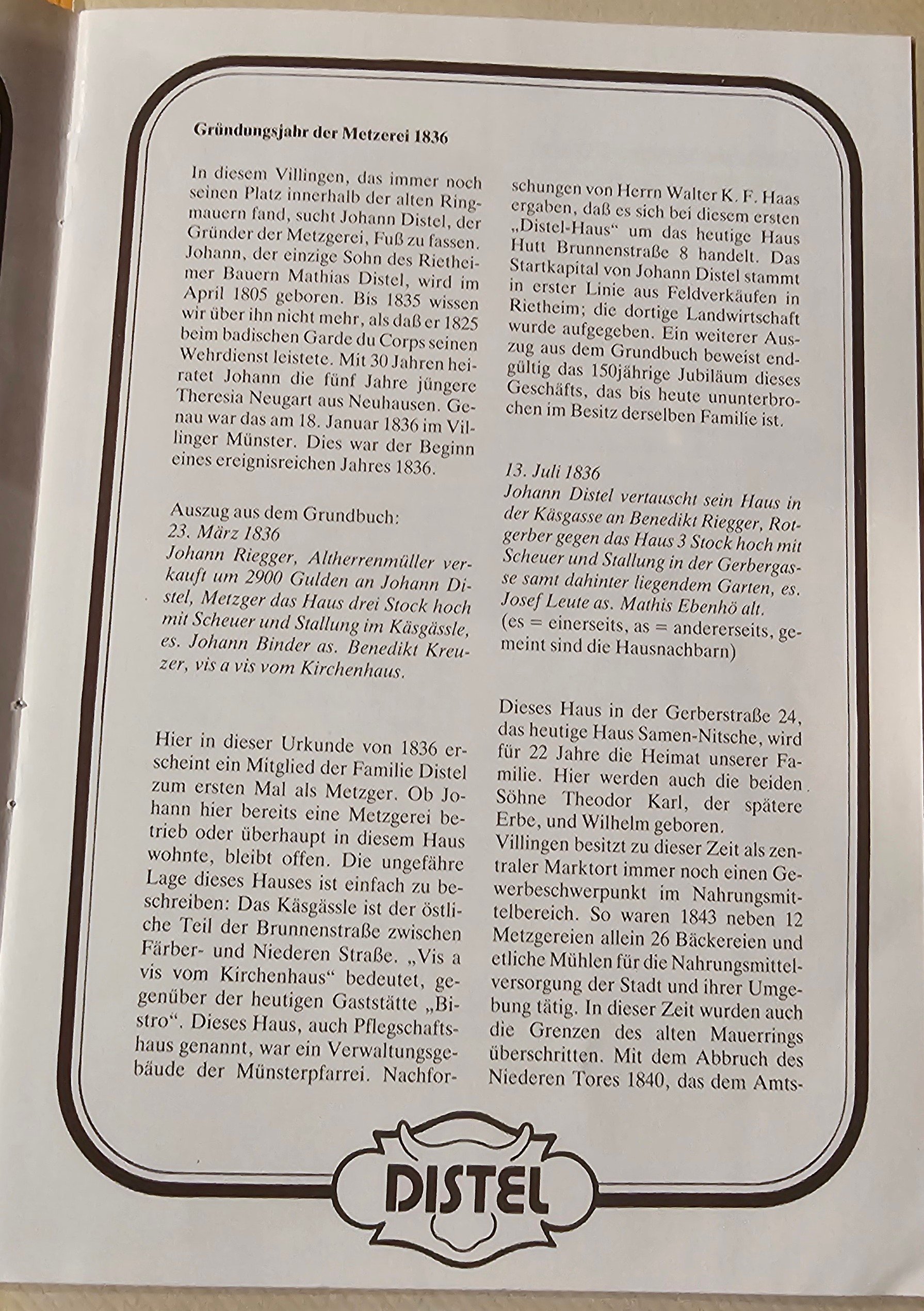
Translated from Ludwig Distel's German.
The founding year of the butchery, 1836
In this Villingen, which still kept within the old ring walls, Johann Distel, the
founder of the butcher's shop, sought to establish himself. Johann, the only son
of the Rietheim farmer Mathias Distel, was born in April 1805. Down to 1835 we
know no more about him than that in 1825 he did his military service with the
Baden Garde du Corps. At the age of 30 Johann married Theresia Neugart of
Neuhausen, five years his junior. To be exact, that was on 18 January 1836 in the
Villingen Muenster. This was the beginning of an eventful year, 1836.
Extract from the land register:
23 March 1836
Johann Riegger, the Altherren miller, sells for 2,900 gulden to Johann Distel,
butcher, the house three storeys high with barn and stabling in the Kaesgaessle,
on one side Johann Binder, on the other Benedikt Kreuzer, opposite the parish
office house.
Here, in this deed of 1836, a member of the Distel family appears for the first
time as a butcher. Whether Johann was already running a butcher's shop here, or
even living in this house at all, remains open. The approximate position of the
house is easy to describe: the Kaesgaessle is the eastern part of the
Brunnenstrasse between Faerberstrasse and Niedere Strasse. "Opposite the parish
office house" means opposite today's "Bistro" inn. That building, also called the
Pflegschaftshaus, was an administrative building of the Muenster parish.
Research by Mr Walter K. F. Haas established that this first "Distel house" is
today's Haus Hutt, Brunnenstrasse 8. Johann Distel's starting capital came
chiefly from selling fields in Rietheim; the farm there was given up. A further
extract from the land register proves conclusively the 150-year anniversary of
this business, which has remained in the possession of the same family without a
break to this day.
13 July 1836
Johann Distel exchanges his house in the Kaesgasse with Benedikt Riegger, tanner,
for the house 3 storeys high with barn and stabling in the Gerbergasse together
with the garden lying behind it, on one side Josef Leute, on the other Mathis
Ebenhoe the elder.
(es = on one side, as = on the other side; the neighbours are meant)
This house at Gerberstrasse 24, today's Haus Samen-Nitsche, was our family's home
for 22 years. It was here too that the two sons were born - Theodor Karl, the
later heir, and Wilhelm.
Villingen at this period, as a central market town, still had a concentration of
trade in foodstuffs. In 1843, besides 12 butchers, there were 26 bakeries alone
and a number of mills supplying food to the town and its surroundings. In this
period the bounds of the old ring wall were also passed. With the demolition of
the Niederes Tor in 1840, which had to make way for the district
[shop sign:] DISTEL
The German as printed in 1986, as transcribed.
Gruendungsjahr der Metzerei 1836
In diesem Villingen, das immer noch seinen Platz innerhalb der alten Ringmauern
fand, sucht Johann Distel, der Gruender der Metzgerei, Fuss zu fassen. Johann,
der einzige Sohn des Rietheimer Bauern Mathias Distel, wird im April 1805
geboren. Bis 1835 wissen wir ueber ihn nicht mehr, als dass er 1825 beim
badischen Garde du Corps seinen Wehrdienst leistete. Mit 30 Jahren heiratet
Johann die fuenf Jahre juengere Theresia Neugart aus Neuhausen. Genau war das am
18. Januar 1836 im Villinger Muenster. Dies war der Beginn eines ereignisreichen
Jahres 1836.
Auszug aus dem Grundbuch:
23. Maerz 1836
Johann Riegger, Altherrenmueller verkauft um 2900 Gulden an Johann Distel,
Metzger das Haus drei Stock hoch mit Scheuer und Stallung im Kaesgaessle,
es. Johann Binder as. Benedikt Kreuzer, vis a vis vom Kirchenhaus.
Hier in dieser Urkunde von 1836 erscheint ein Mitglied der Familie Distel zum
ersten Mal als Metzger. Ob Johann hier bereits eine Metzgerei betrieb oder
ueberhaupt in diesem Haus wohnte, bleibt offen. Die ungefaehre Lage dieses
Hauses ist einfach zu beschreiben: Das Kaesgaessle ist der oestliche Teil der
Brunnenstrasse zwischen Faerber- und Niederen Strasse. „Vis a vis vom
Kirchenhaus" bedeutet, gegenueber der heutigen Gaststaette „Bistro". Dieses
Haus, auch Pflegschaftshaus genannt, war ein Verwaltungsgebaeude der
Muensterpfarrei. Nachforschungen von Herrn Walter K. F. Haas ergaben, dass es
sich bei diesem ersten „Distel-Haus" um das heutige Haus Hutt Brunnenstrasse 8
handelt. Das Startkapital von Johann Distel stammt in erster Linie aus
Feldverkaeufen in Rietheim; die dortige Landwirtschaft wurde aufgegeben. Ein
weiterer Auszug aus dem Grundbuch beweist endgueltig das 150jaehrige Jubilaeum
dieses Geschaefts, das bis heute ununterbrochen im Besitz derselben Familie ist.
13. Juli 1836
Johann Distel vertauscht sein Haus in der Kaesgasse an Benedikt Riegger,
Rotgerber gegen das Haus 3 Stock hoch mit Scheuer und Stallung in der
Gerbergasse samt dahinter liegendem Garten, es. Josef Leute as. Mathis Ebenhoe
alt.
(es = einerseits, as = anderseits, gemeint sind die Hausnachbarn)
Dieses Haus in der Gerberstrasse 24, das heutige Haus Samen-Nitsche, wird fuer
22 Jahre die Heimat unserer Familie. Hier werden auch die beiden Soehne Theodor
Karl, der spaetere Erbe, und Wilhelm geboren.
Villingen besitzt zu dieser Zeit als zentraler Marktort immer noch einen
Gewerbeschwerpunkt im Nahrungsmittelbereich. So waren 1843 neben 12 Metzgereien
allein 26 Baeckereien und etliche Muehlen fuer die Nahrungsmittelversorgung der
Stadt und ihrer Umgebung taetig. In dieser Zeit wurden auch die Grenzen des
alten Mauerrings ueberschritten. Mit dem Abbruch des Niederen Tores 1840, das
dem Amts-
[Schild:] DISTEL